HOWARD STANTEN COACHING

  • HOME
  • Trainings
  • About Me
  • What is Coaching?
  • COACHING SERVICES
    • Executive Leadership Coaching
    • Professional Development Coaching
    • Team Alignment
    • Couples Coaching
    • CTI Certification Coach
    • Regenerating Images in Memory
  • Blog
  • Contact
  • HOME
  • Trainings
  • About Me
  • What is Coaching?
  • COACHING SERVICES
    • Executive Leadership Coaching
    • Professional Development Coaching
    • Team Alignment
    • Couples Coaching
    • CTI Certification Coach
    • Regenerating Images in Memory
  • Blog
  • Contact

Beware of Hijacked Values

10/4/2016

2 Comments

 
Picture
Howard Stanten MPT, CPCC

When we are in-sync with our highest values, we are happy, in flow, and at peace.  When we are in conflict with our values, we feel unhappy, self-conscious, and unsettled.

Take the example of the manager whose top values are honesty and fairness.  She meets with a direct report and speaks with candor about what is going well and what needs improvement.  She gives him an opportunity to speak honestly to her and sends him on his way with new resources to help him succeed.  All is good in the world.

Same scenario, except the manager has just been lambasted by her boss.  She meets with the same direct report and ignores what is working well, tells him he needs to find a way to improve ASAP, and sends him on his way, tail between his legs.  She feels anxious and disturbed.

First scenario: values honored: at peace.  Second scenario: values dishonored: unsettled.

Yes, and…If it were only this simple.

YES, do become intimately familiar with your values.  YES, frequently assess if you’re acting in harmony with your values, especially at those times when you are feeling uncomfortable in your own skin.

AND THEN, watch out for beguiling saboteurs, those voices in your head that scream you’re not good enough, smart enough, credentialed enough, creative enough…
.
You see, saboteurs are experts at making themselves look like your values.  Following the voice of a saboteur posing as your best and highest self leaves you feeling like you are in conflict with your values; unhappy, self-conscious, and unsettled.

My top value is integrity.  Starting out as a coach, I couldn’t get out of my own way as I stepped into the world of building my business through networking.  What I thought was my integrity value was telling me, “You are lying to your potential clients.  You’re not a coach, you only have a handful of clients. You’re wanting to be a coach but certainly don’t have the experience to back it up.” 

My coach pointed out to me that my hyper achiever and perfectionist saboteurs we’re having a field day posing as my integrity value. Initially, I didn’t get it.

He asked me, “What is your intent?”

I responded, “I have a gift I want to bring to the world.  I can see other people’s magnificence and reflect it back to them in a way that gets them into action around what they really want.”

“Does that feel like a lie, like you’re unqualified?" My coach asked.

“No.  It feels like I am doing exactly what I’m here to do.”

When those words came out of my mouth, the saboteurs scattered like cockroaches.  I understood that my saboteurs had so distorted what it meant for me to “be in integrity,” that it would never be possible for me to succeed as a new coach.

 Connecting to my intent, allowed me to get in-sync with my integrity value and start building my business with the confidence of someone who knew he could make a positive difference in people’s lives.

So, the next time it seems like you’re honoring your highest values but you’re feeling unhappy, self-conscious, and unsettled, ask yourself, “What is my intent?”  Get connected to that.  Then, take a look back at your highest values.  If you’re feeling happier, more in flow, and at peace, seize the day!  And, go out into the world and start doing the good work only you can do. 


2 Comments

Taking Responsibility

9/26/2016

0 Comments

 
Picture
By Howard Stanten MPT, CPCC


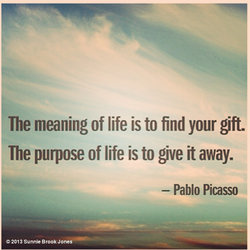
The Native American Lakota people teach us about the Ten Sticks of Happiness.  The First Stick is “I am learning that I am the most unique and special manifestation of creation.” We all have unique gifts to bring to the world.

For most of us, our conscious connection to these gifts tends to ebb and flow through phases of knowing and not knowing, seeking and hiding, and even denying.

When disconnected, we think this “unique gifts” stuff is bullshit. “There just isn’t anything special about me!”   We judge ourselves. We are afraid to know ourselves and resist attempts to “see” our highest and best selves.  In this state of being, we retreat, holding back our gifts from others.

When connected, we tend towards loving ourselves for WHO WE REALLY ARE.  In this state of BEING, we are ideally prepared to get into the DOING of bringing our gifts to others.

I believe, when we are in this connected state, we have a RESPONSIBILITY to get into the nuts and bolts goal directed action of bringing whatever our unique gift is into the lives of others.  This is the space where meaningful lives flourish.

When we are in this connected state, we are most prepared to get over our fine selves (and all the blaming, complaining, victim stories, and self-limiting beliefs that are holding us back) and into answering this question: “Who am I not to bring ‘the most unique and special manifestation of creation to the world?”

Be with that for a while….and then, start walking down the path of making a difference in the world armed with the best of who you are.  We need you, more than ever.


0 Comments

Balancing Chaos and Order in Complex Times

9/9/2016

1 Comment

 
By Howard Stanten, CPCC
 
A carelessly tossed cigarette stub whirls its way into the dehydrated scrub grass on the side of the road. Hyper-alert field mice shift and scatter from at once searching for food and hiding from the low flying hawks. They shift because their world is burning.
Weeks without rain, the surrounding forest is soon crackling in pain. The billowing smoke causes the hawks to shift and soar high above tree line. They shift because their world is burning.
And so it goes, nature erupting into chaos. The seemingly random act of a human being tips the delicate balance from sustainable order into a no holds barred path of destruction that at first glance appears to leave no hope for the return of life. Of course, in one form or another, life will likely return.  Natural systems organize themselves this way. Chaos is, perhaps counter-intuitively, essential to sustainability.  Why?

The inevitable quake of change initially brings chaos to order. This disruption, while at first dis-integrating, also holds the possibility for creatively  re-integrating in new ways. This creative power, in turn, allows the system to return to a renewed state of order, for the time being.
To be sustainable, any system needs to meet the challenges posed by change as an opportunity for growth and, when necessary, re-emergence. To be sustainable, any system must be capable of shifting the way it is organized. The shift may be as simple as a movement in physical space. The seeds from the burning trees are carried by the draft of the heat to an open field. Or, as complex as a leap that somehow lands amidst new genetic code. Some call this deeper response Evolution, some call it the will of God, and others simply approach it with awe and reverence.  “Change or die” may be stark and insensitive, but its ring speaks a universal truth. Natural systems survive or break apart to the degree that they are able to adapt.  The sustainability of all natural systems, is at once threatened and protected by the energy released in the inevitable ebb and flow of chaotic storms.
The same is true for human systems.  Arguably at the top of the evolutionary chain, our self-consciousness allows us to “see” our role in all of this.  This gift of this awareness is a double-edged sword.  On the one hand, we are able to be proactive in promoting the survival of the systems we create. On the other, we can consciously sow the seeds of our own destruction. Consider the development of life saving medicines alongside the deployment of weapons of mass destruction.   Unlike mice, hawks, and trees, humans have the capacity to consciously choose how we will dance the dance between chaos and order.  We are at our best when we honor the differences we all bring to this dance.  We are in the most danger when we shun our differences and hide behind the armor of fear and distrust.

Effective leaders embrace differences and embrace the inevitability of change. As they do, they seek tools and methods that allow chaos to breathe creativity into their organizations. They also know that unbridled chaos is not sustainable.  Chaos needs a container to provide shape, direction, scope and….order.  Chaos needs a shepherd to show the way, define the path, set the vision and and hold the edges of the container together so that the flames continue to burn in such a way that the landscape is cleared of debris; allowing new ideas to emerge and the system as a whole to survive and thrive.  The miracle of natural systems is that they tend to shepherd themselves.  They are “self” organizing and evolve along a path that weaves between chaos and order, between creativity and sustainability.

Human beings, when they recognize this and allow it to happen, do the same thing. After all, human beings are part of nature; and human beings love to organize themselves.   When human beings organize behind iron fisted control, the results are predictable. The system will eventually spiral into chaos.  Lacking the discernment involved in walking the path between order and chaos, such systems inevitably become consumed by chaos and die.
Today’s leaders seek new ways to organize themselves, their people, and their systems. There is a growing sense that adapting to the rising tide of complexity fueled by globalization, lighting fast communication, instantaneous information sharing, and the diversity of cultures and belief systems brought together by all of this, requires a shift in approach.
The fire is burning. The mouse shifts and scatters, the wind shifts and carries the trees seed, the hawk shifts and soars high, and the far-sighted leader shifts and gathers the shepherd’s staff. Climbing to a high spot along the path between chaos and order, this leader embraces the possibilities the fire brings and shouts for the willing to participate in leadership together.  This leader realizes that the fires of change are unleashing powerful questions and that the answers to these questions will come not from the ideas of an isolated few but from the wisdom of the group. This leader is about the collective harvest of new ideas that will sustain the mission of the organization.  This leader is ready to bring the generative nature of collaborative methods into a collective deep dive that gets those involved to show up with the intention and attention necessary to adapt successfully to the complexity that defines our age.

1 Comment

Build a Circle and They Will Come...

8/14/2016

1 Comment

 
Regardless of where on the spectrum of formal structure a present day meeting may lie, a simple yet powerful assumption most often hangs in the shadows:  “Silence means consent!” These words are specifically spelled out in Robert’s Rules of Order.  Even meetings that take place with far less structure and order tend to make this assumption.

“Anyone have anything to add? Any further comments?…..(silence)… Good then, it’s decided…..”   The leader smiles and nods.  The formal meeting adjourns.   And, the informal meetings begin to buzz in the hallways and parking lots.
These whispered conversations defy both the implied threat and presumed reality that somehow if we don’t speak in a meeting we are giving our consent. These meetings after the meeting are most often interwoven with strands of creative ideas buried under the weight of disillusioned dissent.


The flip side of the empty promise of “silence means consent” is that point in a meeting when ideas are becoming so divergent and the energy so seemingly scattered and frenetic that the leader, with a raised hand and loud voice, shuts down the conversation deeming it “unproductive,” or “better left for discussion at another time.”   Frequently, this declaration is followed by a quick unilateral decision intended to “move things forward.”  And, the informal meetings begin to buzz in the hallways and parking lots…. Consent is assumed while silent voices are left unheard and order is validated. Consent is lost while divergent voices are silenced and control is imposed. On either side of this same coin, creative ideas are either never heard or never given the chance to converge into meaningful action.  If we can agree that our people are our organization’s most valuable asset, surely we can agree that in order to be most successful, we would be wise to leverage this most valuable asset to the greatest extent possible.  When we leave voices unheard or squelch voices that diverge, we under-utilize our best asset and risk introducing unnecessary inefficiency into our decision-making process, leaving solutions unharvested in a field of unrealized possibilities.

Habit steeped in protocol, work appropriate social masking, and conformity to expectation tend to dominate our way of being together in the workplace. After all, control and order are the traditional pillars upon which efficiency is built, be it in production or service.  The well thought out plan of leadership needs only to be executed and expected results should follow.  So simple. So….why is leadership so often immersed in putting out fires that use systems as kindling?  Why aren’t “they” embracing the system, meeting expectations, proactively solving problems, and committing to the program?  Why does everything always have to be so complicated??

Because, human beings are complicated.   And, human beings are meaning makers. From the first hieroglyphics etched into the walls of caves, to the tribal councils sitting around the fire, to the Bible, Koran, the Renaissance, the industrial revolution, the space age, to today, human beings struggle and revel in the process of making meaning.  The gift of consciousness allows us to be aware of our ability to shape and contribute to our world.  The ability to make meaning using the tools of an evolved consciousness defines our humanity, what it is that makes us human.  Most of us, at some level, strive to connect, share with, and contribute to each other’s lives and the world around us.  We bring our humanity into the arena of community where our individual world views are tested, welcomed, challenged, and shaped.


As we bring our humanity into our work places and organizations, we often encounter an unsettling shift that requires us to leave some part of who we are (as meaning making humans) hidden behind a mask.  A tension often develops between the kind of person we feel we are and want to be and the person we are expected to be or think we are supposed to be in order to be successful. This tension may result in our giving silently resentful consent or loudly disrespectful dissent when we enter into meetings.  Either way, our voices are often left unheard.  And, valuable assets are left underutilized. What if instead of individuals trying to figure out what “mask” might offer them the best opportunity for success, the structure of the meeting was reshaped?

What if this structure invited the participants to show up without any mask at all? The sign outside the meeting room might read, “Humanity Welcomed!”

Circle Process is a meeting methodology that offers such a reshaping. Literally and figuratively. The rectangular table is removed and the chairs arranged in a circle. The center is filled with tokens of meaning for that particular organization, perhaps a mission statement, pictures and testimonials of delighted clients, or smiling patients recovered from illness. We speak with intention and listen with attention. We agree to guidelines that give order to the meeting as we share responsibility for holding each other accountable to adhering to those guidelines. Silent voices are respected without any presumption of meaning.  These voices frequently emerge as trust is built through the sharing of stories.  Divergent voices are respected without attempts to silence their input.   The principles and practices of Circle Process provide a structure that allows and encourages divergence to follow its natural course increasing the opportunity for convergence around synergistic solutions. As silent voices find their voice and divergent voices find ways forward not previously imagined, human assets become highly leveraged and decision-making actually gains efficiency through the creation of sustainable solutions.

Everyone may not always agree with the final decisions. However, using a process that respects and values our humanity will more likely result in time previously spent whispering in the hallways being spent accomplishing the shared mission.

1 Comment
Forward>>

    Author

    Howard Stanten MPT,CPCC is an Executive Leadership and Professional
    Development Coach helping leaders and entrepreneurs bring the best of who they are to those they lead and serve.

    Categories

    All
    Couples Coaching

    Archives

    October 2025
    June 2019
    May 2019
    January 2019
    December 2017
    July 2017
    May 2017
    April 2017
    March 2017
    January 2017
    December 2016
    November 2016
    October 2016
    September 2016
    August 2016

    Categories

    All
    Couples Coaching

    RSS Feed